
Abstract
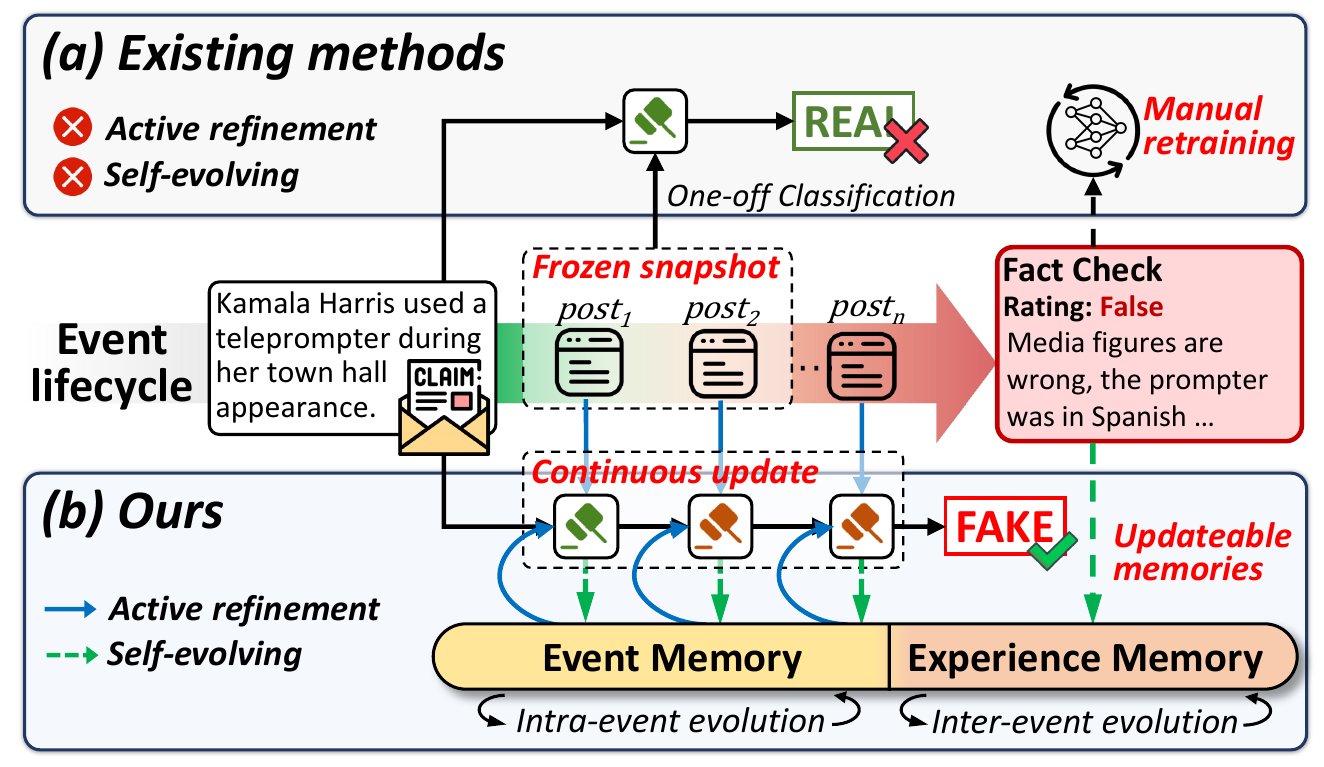
Real-world fake news is inherently dynamic: evidence within an event accumulates and conflicts over time, while deceptive tactics shift across events. However, most prior work formulates detection as a static, one-shot classification problem over fixed snapshots. This mismatch ignores the lifecycle of news and leaves detectors unable to update judgments as an event unfolds or adapt in non-stationary environments where previously learned patterns quickly become obsolete.
As an alternative, we propose active, non-parametric evolution for fake news detection. EvoFEND is a dual memory-driven self-evolving agent: Event Memory maintains a dynamic working context over streaming evidence, while Experience Memory distills transferable lessons from historical cases to steer future reasoning. We also construct XNews-25, a benchmark that supports evaluation with recent streaming data.
Dataset Construction: XNews-25
XNews-25 is constructed to evaluate fake news detection under realistic streaming conditions while reducing data leakage for LLM-based methods. It contains 802 events, fact-checking reports, and 59,706 associated social media posts.
Events are divided into small, medium, and large subsets by the number of associated posts, enabling evaluation at different levels of information sufficiency.
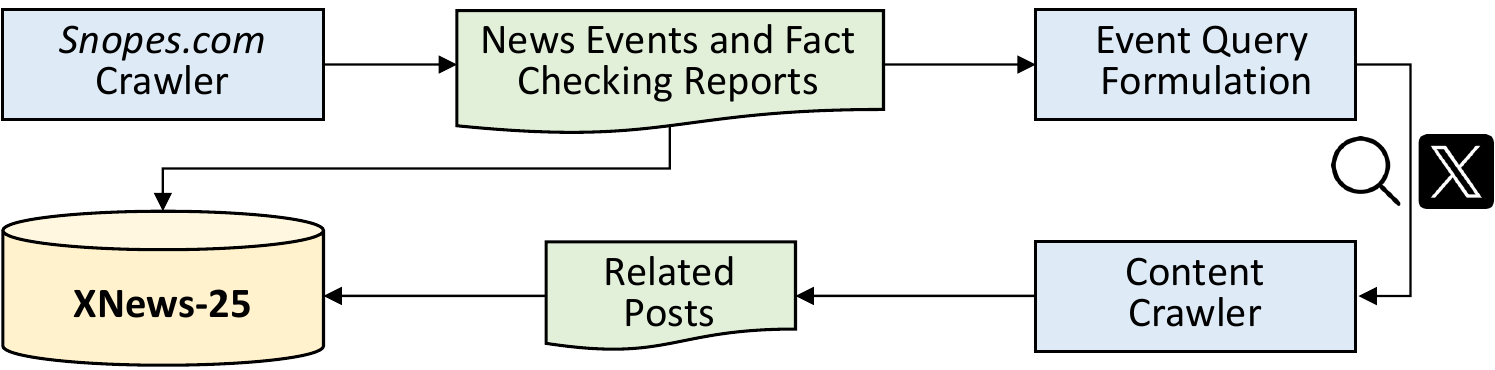
Illustration of dataset construction pipeline.
Proposed Method: Dual Memory-Driven Self-Evolving Detection
EvoFEND transforms fake news detection from a static classification task into an active, self-evolving process. Its Event Memory tracks state changes within active events, while Experience Memory evolves across concluded events by reflecting on fact-checking reports.
Online reasoning continuously routes posts, refines evidence, retrieves relevant experiences, and updates the event state. Post-hoc reflection then samples historical snapshots and distills corrected analyses and evolutionary lessons.
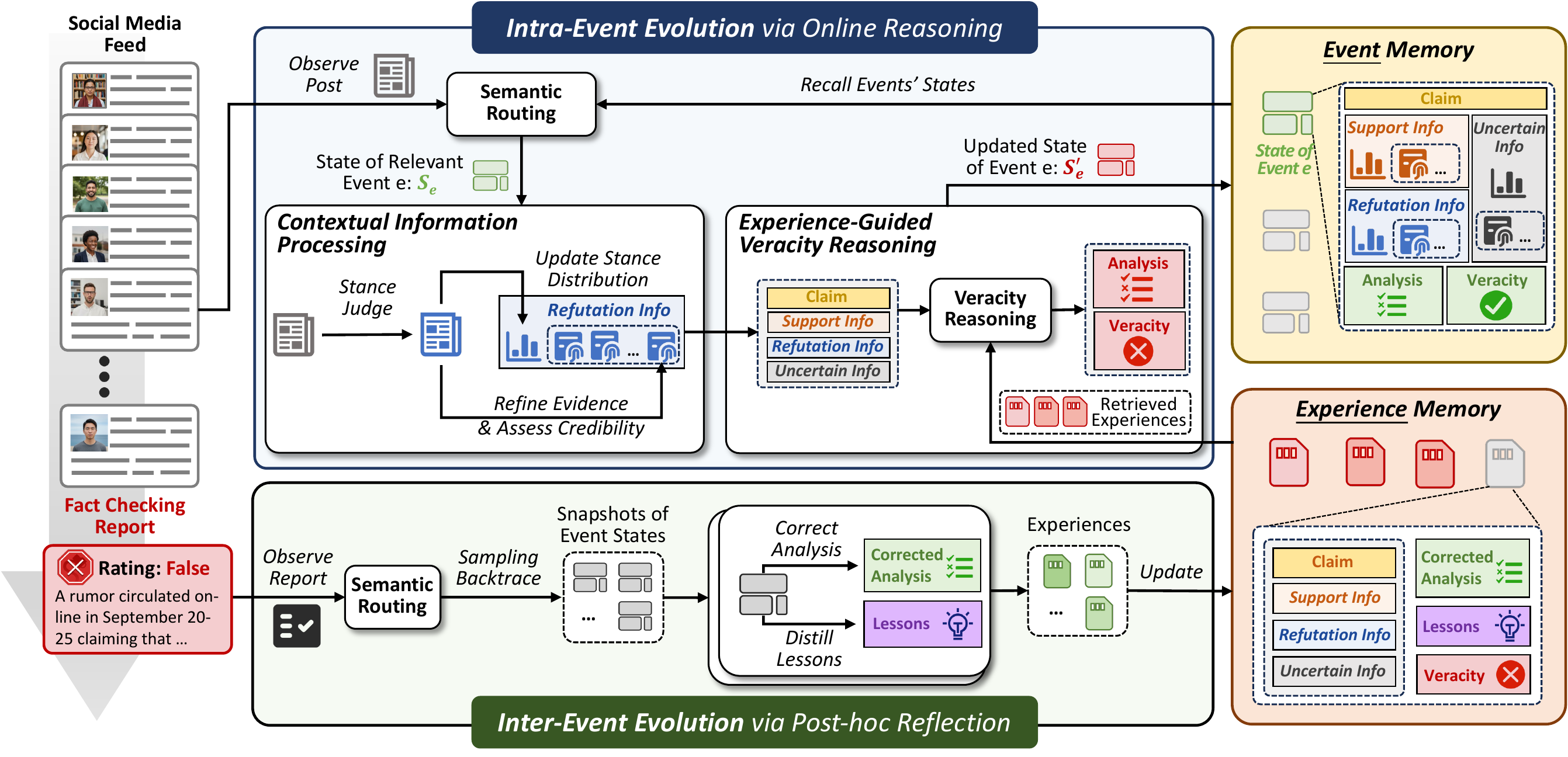
Overview of the EvoFEND framework. EvoFEND constantly monitors and analyzes the social media feed to continuously refine the veracity judgment of a claim and improve its own internal knowledge from concluded events. EvoFEND has two evolution lines: 1) Intra-event evolution via online reasoning, which initializes events, accumulates evidence, and updates judgments backed up by event memory; and 2) Inter-event evolution via post-hoc reflection, which internalizes lessons from concluded events based on the event state snapshots and fact-checking reports. Driven by the dual memory mechanism, EvoFEND can constantly perform self-evolution even after deployed in real-world streaming data. The avatars are AI-generated.
Experiments
EvoFEND is compared with non-LLM and LLM-based baselines under content-only and context-aware settings. The results show that explicit event-state tracking and experience evolution deliver robust gains across subsets of different scales.
Ablation studies verify the value of contextual refinement, experience guidance, diverse snapshot sampling, and reflection.
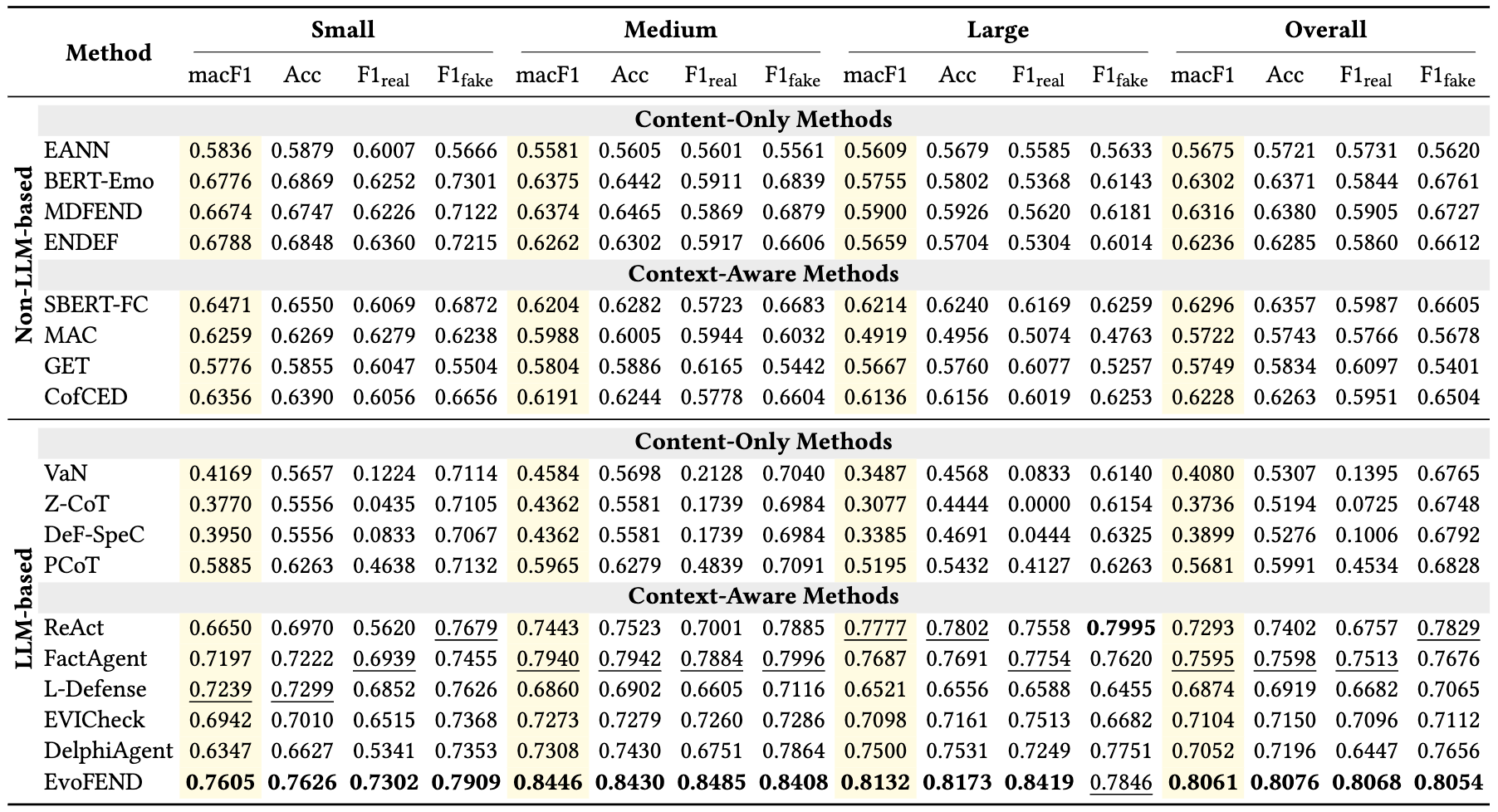
Performance comparison of EvoFEND and baselines on subsets of varying scales in XNews-25. The two best results in each column are bolded and underlined, respectively.
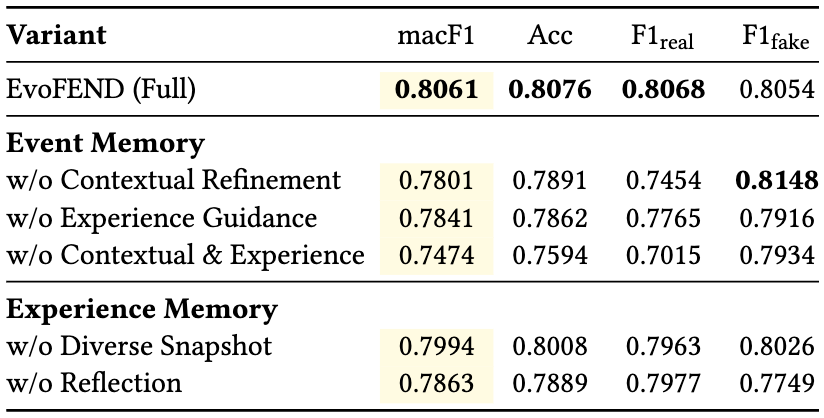
Overall performance comparison of EvoFEND and its variants. The best results in each column are bolded.
Further Analysis
EvoFEND remains stable under streaming evidence and robust to routing-induced noise. These analyses show that the framework can update continuously without becoming overly sensitive to noisy posts.
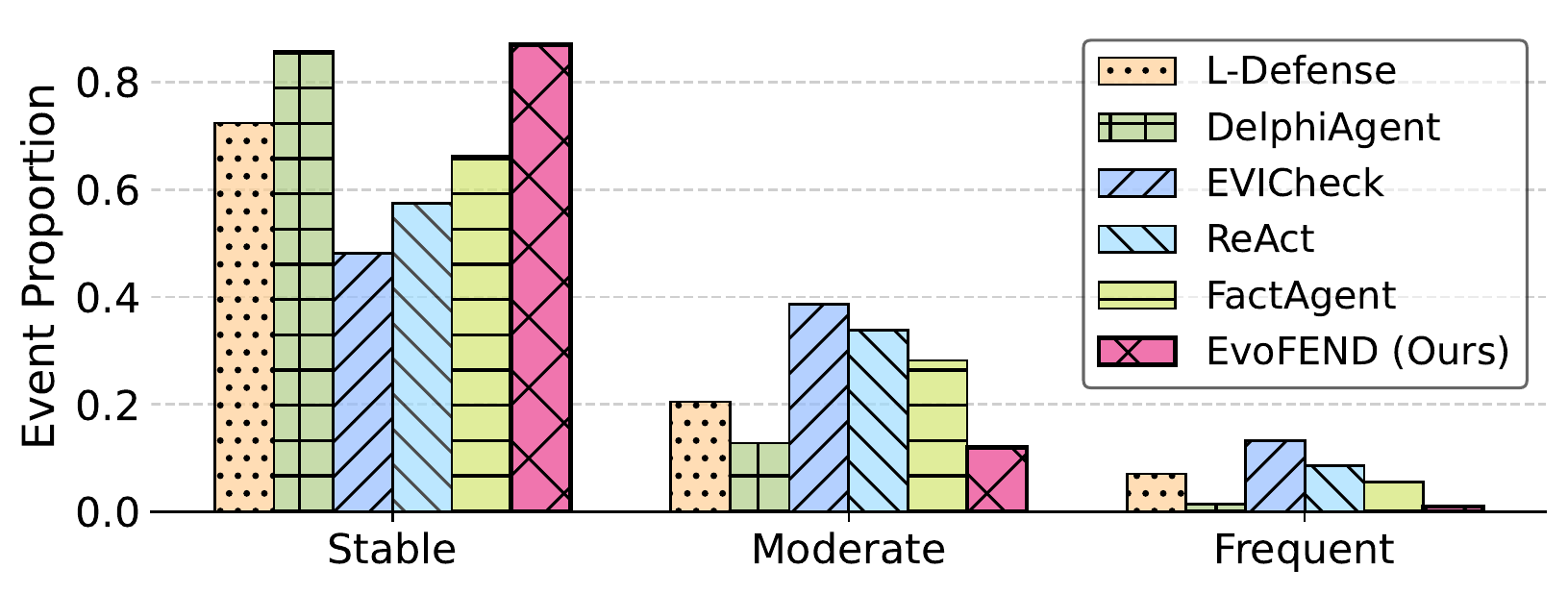
Analysis of decision stability based on prediction flip frequency (presented in an ascending order of macro F1).
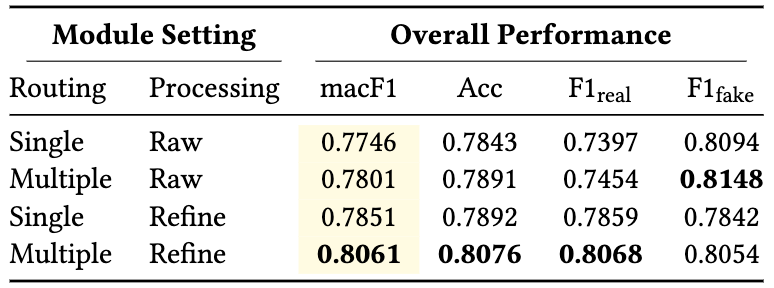
Performance comparison under different routing and information processing settings.
Conclusion
We proposed EvoFEND, the dual memory-driven self-evolving fake news detection framework. Driven by the dual memory for events and experiences, EvoFEND can monitor news events' state, update news veracity judgments, and form a reflective experience after an event terminates, enabling self-correction and self-evolvement functions. Experiments demonstrated the superiority of EvoFEND.
EvoFEND exemplifies how to build a self-evolving LLM agent framework tailored for fake news detection in streaming data environments. By shifting the learning paradigm, a fake news detector can perceive how fake news events emerge and terminate from a broader data stream view and update itself at every moment, which would largely strengthen its adaptation to a rapidly changing environment.
This approach blurs the distinction between training and inference, emphasizing the critical role of test-time evolution and showcasing the feasibility of constant self-improvement in real-world deployments. We expect EvoFEND to encourage more exploration for the next generation of self-evolving misinformation detectors.
BibTeX
@inproceedings{10.1145/3770855.3817673,
  author = {Hu, Beizhe and Sheng, Qiang and Mi, Hao and Wu, Jiaying and Wang, Zhengjia and Yu, Yuanlong and Wang, Danding and Hu, Xuming and Cao, Juan},
  title = {{EvoFEND: Dual Memory-Driven Self-Evolving Fake News Detection}},
  booktitle = {Proceedings of the 32nd ACM SIGKDD Conference on Knowledge Discovery and Data Mining V.2},
  year = {2026},
  pages = {1734--1745},
  publisher = {Association for Computing Machinery},
  doi = {10.1145/3770855.3817673}
}